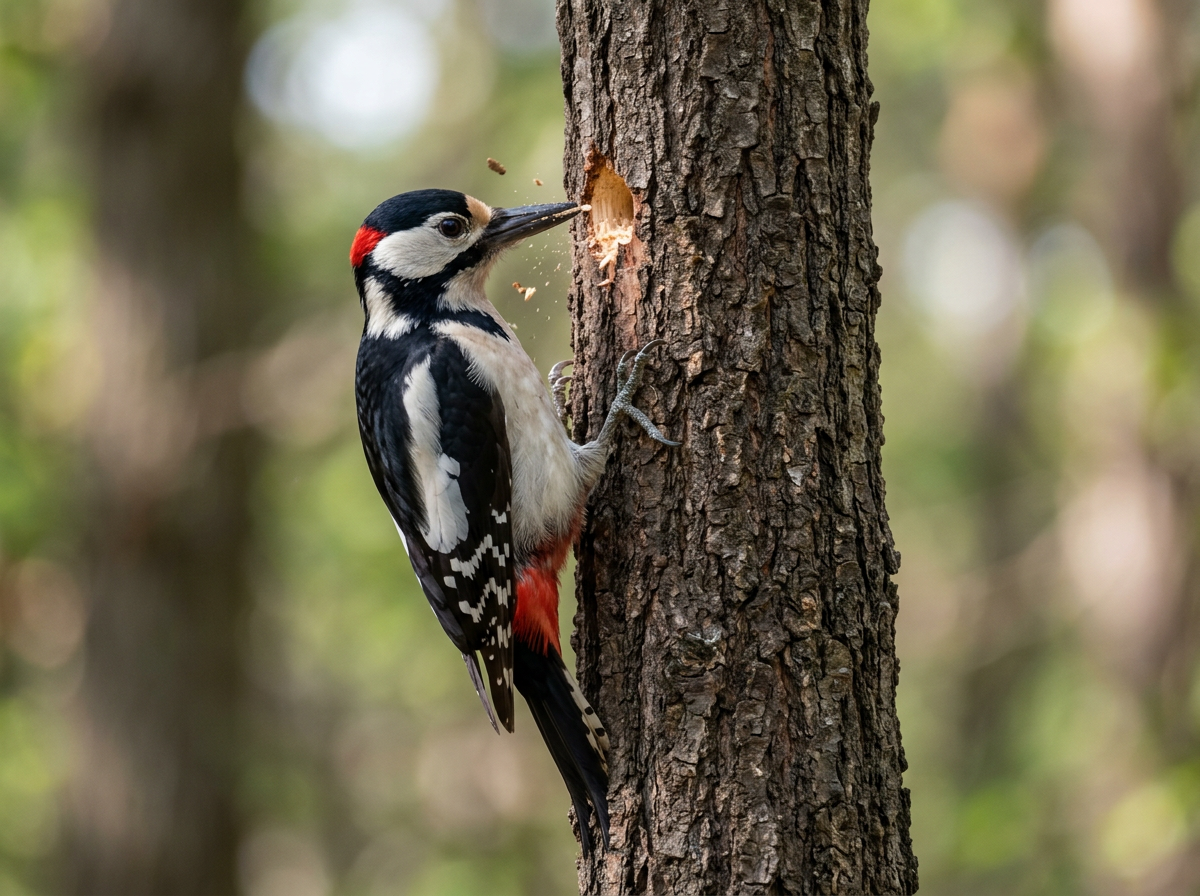
Why Don't Woodpeckers Injure Their Brains?
A woodpecker slams its beak into a tree up to 20 times a second — as many as 12,000 times a day. Each strike hits with forces that would concuss a human on the first blow. This begs the question, "Why don't woodpeckers die from brain injuries?"
The answer is that woodpeckers have a whole system of safety features working in concert:
- A built-in seatbelt. The woodpecker's tongue is about a third the length of its body. It splits in two and wraps around the skull and brain, anchoring everything snugly in place.
- Almost no room to move. The brain fits so tightly in the skull, with barely any fluid around it, that it can't slosh around and bruise on impact the way ours can.
- A rigid, reinforced skull. Rather than cushioning the blow, the skull is built stiff and strong — engineered to drive the force of each strike straight into the wood instead of absorbing it into the brain.
- A straight-line strike. The neck and strike path keep each hit perfectly linear rather than at an angle, avoiding the twisting, rotational forces that would do the most damage to brain tissue.
- An offset beak. The upper and lower halves of the beak are slightly uneven in length, so the impact lands in stages rather than all at once, spreading the force away from the brain.
- Sheer scale. The woodpecker's brain is tiny and light. Less mass means less force acting on it.
All of these features work together to enable woodpeckers to survive a lifetime of pecking. These small birds represent a remarkably precise piece of engineering — the kind of layered, purposeful design that points to a Creator who thought of everything.